
The North American electric grid is often described as the largest machine ever built. It requires constantly balancing electricity supply with demand while maintaining strict reliability standards to keep outages rare. Because of this, new power plants cannot simply be “plugged in” to the grid. When new generation is proposed—such as New Jersey Governor Mikie Sherrill’s recent announcement [1] to pursue new nuclear power plants (NPPs)—extensive studies are required to ensure the project does not disrupt grid reliability. This interconnection process [2] can take years, creating a major bottleneck for new energy projects. To help address this challenge, researchers at the Rowan Energy Collaborative (ROWEC) [3], with seed funding support from the New Jersey State Policy Lab, developed a screening approach to identify promising locations for new nuclear plants. Their work focuses on understanding grid requirements and identifying sites that can connect to existing infrastructure, particularly substations, reducing both development timelines and the need for costly upgrades that are ultimately passed on to electricity customers.
Several regulatory entities play a role in ensuring that new nuclear power plants can safely connect to the grid, including the U.S. Nuclear Regulatory Commission (NRC), the Federal Energy Regulatory Commission (FERC), the North American Electric Reliability Corporation (NERC), the regional transmission operator (RTO), and the local electric utility. Each operates at a different level of the system and has distinct responsibilities. At the federal level, the NRC oversees the safe use of nuclear materials and sets requirements that apply nationwide. Additionally, FERC establishes the rules for how power plants connect to the grid, while NERC defines the technical standards needed to maintain system reliability. At the regional level, New Jersey is part of the PJM Interconnection, which coordinates the flow of electricity across 13 states and the District of Columbia (shown in Figure 1a). PJM is responsible for maintaining reliability on the high-voltage transmission system and managing wholesale electricity markets. It operates under FERC oversight and conducts interconnection studies that must meet NERC reliability standards. At the local level, electric utilities are responsible for delivering power to homes and businesses through the lower-voltage distribution system—the network of power lines most people see in their communities. In New Jersey, four major utilities serve this role (shown in Figure 1b). Because these entities share responsibility, connecting a new NPP requires coordination across all three levels of the electric grid.
Figure 1a. PJM Interconnection service region [4].
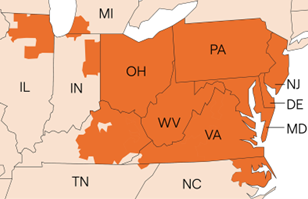
Figure 1b. New Jersey’s electric utility regions.

The NRC sets two key requirements for how nuclear power plants connect to the grid [5]. First, each plant must have at least two independent and reliable sources of external power to ensure critical safety systems, such as emergency cooling, and remain operational even if the plant shuts down. Second, the surrounding grid must be designed to reduce the risk of losing offsite power due to disturbances or low-voltage conditions.
To help evaluate these requirements, the ROWEC researchers are using ArcGIS [6], a geographic mapping and analysis tool, to identify which existing substations in New Jersey are most suitable for connecting new nuclear plants. Their approach focuses on higher-voltage substations (230 kV, 345 kV, and 500 kV), which are more strongly connected to the regional grid and generally more resilient to disruptions.
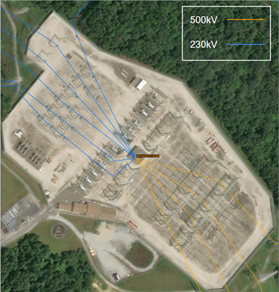
From there, the team evaluates whether each substation has at least two independent transmission paths. In simple terms, this means checking whether external power can reach the substation through separate routes that are unlikely to fail at the same time. For example, two lines that are connected to the same upstream substation—or run along the same physical corridor—may be vulnerable to a single point of failure or a same extreme weather event. Substations that meet these independence criteria are flagged for further analysis. An example is shown in Figure 2.
Figure 2. Example substation analysis using ArcGIS [6].
While NRC requirements focus on ensuring the grid can reliably accommodate the safety operation of a nuclear plant, studies performed by PJM examine the reverse: how a new plant would affect the grid safety. These regional studies evaluate whether adding a large generator could overload transmission lines and/or substations or require infrastructure upgrades. However, conducting these analyses for every potential location can take months, making it impractical for early-stage screening. To address this challenge, the ROWEC team is leveraging the PJM Queue Scope tool [7], which allows users to model a hypothetical new power plant at a specific location and estimate its impact on the surrounding grid. The tool highlights where transmission constraints may occur and what upgrades might be needed. By applying it across multiple candidate locations, the team can quickly identify which sites are likely to require fewer upgrades, helping prioritize locations that could be developed more quickly and at a lower cost.
Furthermore, recent experience from the expansion of new NPPs, such as with Vogtle Electric Generating Plant [8] can provide insight into the necessary infrastructure upgrades needed for New Jersey. Delays in the Vogtle project highlight the importance of early transmission planning. For example, significant upgrades, including new transmission lines and major switchyard modifications, were required to integrate the new reactors into the grid, underscoring the need to identify suitable interconnection points early in the siting process.
As the ROWEC team continues its interconnection analysis work, they plan to engage with industry stakeholders to further refine its approach. Many of the detailed interconnection studies conducted by utilities to determine required transmission upgrades are confidential, which limits their availability for external research. To address this gap, the team plans to meet with PSEG Nuclear [9], the only operator of NPPs in New Jersey, to better understand how these studies are conducted in practice. The team also plans to engage with PJM to further align its methodology with regional planning practices.
Ultimately, the interconnection analysis will be combined with environmental and public engagement considerations to support a more comprehensive approach to nuclear siting. The ROWEC team is integrating these factors into a weighted mapping framework that highlights the most promising locations for new NPPS in New Jersey. To ensure this approach reflects real-world priorities, the team plans to engage with government and industry stakeholders to help inform how these factors are weighted. By bringing together grid reliability, environmental constraints, and community considerations, this framework provides a practical tool to support more informed and efficient siting decisions.
References:
[1] State of New Jersey, “Governor Sherrill announces new nuclear initiative,” Apr. 8, 2026. Available: https://www.nj.gov/governor/news/2026/20260408a.shtml (accessed Apr. 19, 2026).
[2] American Clean Power Association, “Interconnection fact sheet,” June 2023. Available: https://cleanpower.org/wp-content/uploads/gateway/2023/06/ACP_Interconnection_FactSheet_0623.pdf (accessed Apr. 19, 2026).
[3] Rowan University, “Expanding nuclear power in New Jersey,” Available: https://www.rowan.edu/ric-edelman-college/centers/sweeney_center/expanding-nuclear-power-in-nj/ (accessed Apr. 19, 2026).
[4] Enel North America, “PJM demand response,” Available: https://www.enelnorthamerica.com/solutions/energy-solutions/demand-response/pjm-demand-response (accessed Apr. 19, 2026).
[5] U.S. Nuclear Regulatory Commission, “General design criteria for nuclear power plants,” 10 CFR Part 50, Appendix A. Available: https://www.law.cornell.edu/cfr/text/10/appendix-A_to_part_50 (accessed Apr. 19, 2026).
[6] Esri, “ArcGIS platform overview,” Available: https://www.arcgis.com/home/item.html?id=5e499724325749fdad3bfa101cbef015 (accessed Apr. 19, 2026).
[7] PJM Interconnection, “Queue Scope,” Available: https://queuescope.pjm.com/queuescope/pages/public/evaluator.jsf (accessed Apr. 19, 2026).
[8] Renewable Energy World, “Georgia Power upgrades transmission switchgear at Plant Vogtle,” Available: https://www.renewableenergyworld.com/power-grid/grid-modernization/georgia-power-upgrades-transmission-switchgear-at-plant-votgle-nuclear-plant/ (accessed Apr. 19, 2026).
[9] PSEG, “PSEG Nuclear LLC,” Available: https://corporate.pseg.com/aboutpseg/companyinformation/thepsegfamilyofcompanies/psegnuclearllc (accessed Apr. 19, 2026).