
As the next generation of nuclear reactors is slated for deployment, likely within the next decade, state and federal planners and nuclear facility developers have an important role to play in integrating these key energy resources. Long-term plans frequently assess and address community needs for the next 10 to 20 years [11], a timeline that aligns well with the complex nature of development, construction, commissioning, and initial operation of nuclear power plants (NPPs). In addition to tying discussion of nuclear generation into the planning process at large, it also provides ample opportunity to include community-based groups, academic research institutions, and other key stakeholders in collaborative capacities to bolster responsive and equitable siting and operating approaches. Planning scholars and practitioners outline the pertinent planning-related topics, including siting, land use, water use, environmental impact, nuclear fuel storage, and community impact, which must be addressed to promote the sound implementation of new nuclear energy development. To help address several of these long-term planning concerns, researchers at the Rowan Energy Collaborative (ROWEC) [15], with seed funding support from the New Jersey State Policy Lab, are investigating possible siting locations for new NPPs in the state, while analyzing their potential impacts to the surrounding communities.
Siting
Selecting a site for an NPP must be based on a comprehensive and multi-layered evaluation, especially considering that the electric grid has been defined as uniquely critical, enabling the operation of all other critical infrastructure sectors [6]. One vital step is understanding the existing geophysical context. To facilitate this process, Argonne National Lab developed the Geospatial Energy Mapper (GEM) tool, designed to help energy infrastructure developers identify suitable locations across the United States for different generation types, including NPPs [1]. ROWEC found that while this tool provides a good overview of the country, it fails to capture the intricacies necessary for individual state-level planning.
As such, the ROWEC team performed a preliminary siting analysis utilizing ArcGIS Pro, incorporating criteria based on New Jersey regulations, the Nuclear Regulatory Commission (NRC), the International Atomic Energy Agency (IAEA), and a comprehensive review of NPP siting literature [3][11]. From these sources, multiple key factors were identified, including:
- Distance from Fault Lines
- Population Density
- Land Slope
- Cooling Water Availability
- Proximity to Protected Wildlife Preserves
- Evacuation Route Access
- Electric Transmission Lines
Maps showing two of these layers, distance from fault lines and population density, are shown in Figures 1a and 1b, respectively. While many of these layers were analyzed based on the literature, some were explored more in depth to fully capture the planning environment. For example, the literature often defines the “electric transmission lines” layer simply as distance to the nearest transmission line. However, some transmission lines may be overloaded and thus are not suitable for NPP connection without upgrades. These intricacies require further analysis, as described in our team’s previous blog post, Connecting New Jersey’s New Nuclear Generation to the Grid [4]. As the ROWEC team continues its research to develop a comprehensive suitability map for new nuclear generation, one of the key challenges will be in assigning weights to the respective data layers. To address this challenge, ROWEC’s team plans to meet with industry, government and other stakeholders, leading to a comprehensive analysis.
Figure 1. Sample layers used in the ROWEC nuclear siting analysis.
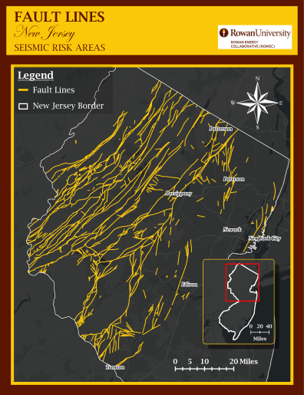
Figure 1a. New Jersey Fault Line Map
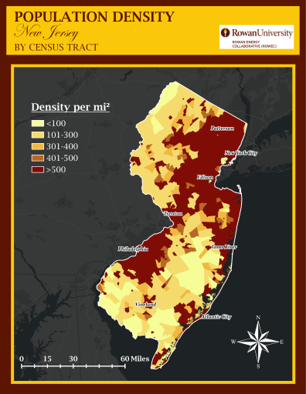
Figure 1b. New Jersey Population Density Map
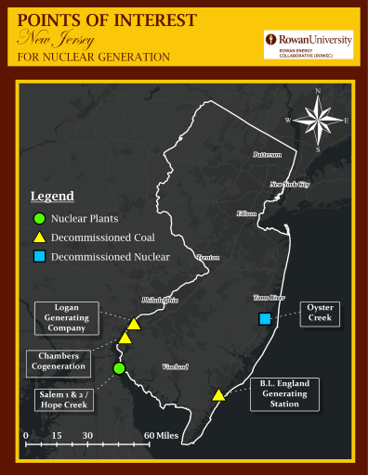
In addition to these general suitability layers, several locations were identified as potentially strong candidates for the installation of new full-sized nuclear reactors or small modular reactors (SMRs). These include the sites of currently operating Salem and Hope Creek nuclear reactors in Salem County, where PSEG Nuclear has proposed building a fourth reactor, and the site decommissioned Oyster Creek nuclear plant in Ocean County, which Holtec has acquired as a potential site for its SMRs. Other sites that could meet the overlay of ArcGIS PRO siting criteria include the sites of three decommissioned coal plants: Chambers Cogeneration in Carneys Point in Salem County, the Logan Generating Company in Gloucester County, and B.L. England Generating in Upper Township in Cape May County. The land for these decommissioned power plants has already been developed, and they typically have a pre-existing grid interconnection point, but their suitability would require further detailed analysis. Figure 2 illustrates the respective locations of these active and retired power plants.
Figure 2. New Jersey operating and retired coal and nuclear power plants.
The NRC is proposing changes that could expand the range of locations considered for new nuclear development [18]. The proposed rules would continue to favor sites with lower population density but would provide greater flexibility to consider locations with higher population densities when the societal risks and benefits of a site can be appropriately demonstrated. This could be particularly important for New Jersey, where large areas of land are densely populated and finding suitable sites for new nuclear generation can be challenging. As the NRC’s proposed rules are finalized, the ROWEC team will incorporate the updated siting requirements into its regional analysis, helping to identify how changes in population-density criteria may affect the list of locations that could be considered for future nuclear development.
Land Use
A challenging aspect of finding locations to install a new NPP, particularly in New Jersey, is finding large enough open land while meeting the siting criteria described above. To address this challenge, governments and industry are investigating small modular reactors (SMRs). SMRs take up significantly less land than their traditional counterparts but also produce less electricity. Most SMRs are expected to require less than 100 acres, while conventional plants average 600 acres, with the footprint of the Georgia Vogtle NPP, the newest nuclear reactors built in the US, utilizing a footprint of 3,000 acres [5][7][11]. However, the two types of plants have similar land use efficiency, with SMRs typically using 1.0-1.6 acres/MW and traditional NPPs using 0.8-2.0 acres/MW [17]. As such, the available lands for use are a driving factor for selecting between the sizes.
There are several compatible land use opportunities associated with SMR siting, including “previously housed fossil fuel facilities, surplus land that once housed asylums, tuberculosis hospitals, defunct malls, inactive military installations, and formerly contaminated manufacturing sites,” [11]. These locations are generally difficult to revitalize, so installing SMRs may restore productivity to these undesirable and underutilized parcels. These compatible land use opportunities align closely with the ROWEC results depicted in Figure 2.
In New Jersey, a notable example is the potential revitalization of the decommissioned Oyster Creek NPP. Holtec International, a U.S.-based nuclear developer, plans to redevelop the site for four SMRs totaling 1.36 GW. Assuming the SMRs are approved for construction at this site, operations are projected to commence in 2036. [14]. In addition to the land-use advantages, redevelopment may offer community benefits by building upon infrastructure, emergency planning resources, and a workforce that is already associated with nuclear generation. The surrounding Lacey Township community also has decades of experience living alongside a nuclear facility, which may provide greater familiarity with nuclear operations and emergency preparedness than would be expected in a community encountering nuclear generation for the first time [8].
As current planning practice continues to emphasize mixed use and smart growth principles, the impact that SMRs may have on future development should be considered, given that residential, commercial, and light manufacturing operations may be interspersed. While the smaller size associated with SMRs may provide a strong selling point for local communities, a full analysis and plan for safety, security and waste storage, with assumptions included for the potential incremental addition of new modules should be considered. Establishing a maximum overall plant size for each parcel with a plan for incremental reviews and adequate protection as the site is scaled will be essential to ensure safe and sustainable expansion of capacity.
Nuclear Waste Storage and Management
Once a feasible location has been identified for a new NPP, a key operational challenge is the storage of the spent nuclear fuel. Even though the spent fuel no longer has enough energy for use in NPPs, it still emits radioactive energy and thus must be carefully stored. A federal centralized storage location within Yucca Mountain, Nevada was proposed in 1982. However, due to political opposition to transportation of spent nuclear fuel, this storage solution was halted. Since then, standard practice in the U.S. has been to store spent fuel onsite in heavily shielded water pools and steel and concrete storage containers at the NPP where it was consumed. This has been the practice at the currently operating Salem and Hope Creek NPPs and at the site of the decommissioned Oyster Creek plant. While this solution has been demonstrated to be safe and effective, a growing concern has been the shrinking onsite storage capacity, as new spent fuel is continually produced [10].
Several solutions to spent nuclear fuel have been and are currently being developed. The simplest is to design NPPs to store more fuel. However, this increases land usage, which is particularly difficult in densely populated New Jersey and increases lifetime costs. Another solution is to use advanced nuclear fuel, which is enriched beyond the industry standard of 3-5%, resulting in increased efficiency and decreased fuel waste. While relatively new, use of this advanced fuel has been proposed in the new NRC regulations [18]. It is actively being tested at the Vogtle NPP and could potentially be used in future reactors [9]. Additionally, nuclear fuel waste could be reprocessed by separating the useful chemicals (including usable uranium) from the spent waste, thus decreasing the volume that must be stored [10]. While not currently used in the United States, several countries in Europe and Asia have implemented this technology. These solutions, in addition to others, are leading the nuclear industry to improved sustainability and security.
Citizen Participation
The National Academies of Sciences, Engineering, and Medicine have found that public engagement and consideration of community values have historically played a limited role in nuclear reactor design and siting [12]. This can foster an environment in which decision making appears opaque and local citizens have limited influence over the actions being taken around their homes. Arnstein’s Ladder of Citizen Participation (illustrated in Figure 3) [2][11], suggests these institutions move away from non-participation and “tokenism” and instead shift toward true civic engagement where partnerships, delegated power, and citizen control are situated at the forefront. For the successful integration of new NPPs, achieving these highest rungs of Arnstein’s Ladder would improve public awareness as well as buy-in and yield other positive outcomes. Moreover, Mullin and Kotval [11] advocate that community planners incorporate a “Consent Based Siting” approach, which is described as: “requiring the promoters of a proposed plant to meaningfully engage the local community on issues such as design, location, safety and security. If they obtain the community’s approval, the promoters would then submit their design certification documents to the regulators.”
To address this concern, New Jersey is taking steps toward a more participatory approach to nuclear development. Governor Mikie Sherrill’s Nuclear Policy Task Force has identified public trust and confidence as one of its five primary areas of focus, recognizing that successful nuclear development requires more than technical and economic considerations [13]. This emphasis has been reflected in public forums such as Rowan University’s June 2026 conference on Expanding New Jersey’s Nuclear Generation Capacity, which brought together state government officials, nuclear industry representatives, environmental and energy policy experts, labor representatives, and academics to discuss the future of nuclear energy in New Jersey [16]. Through these efforts, New Jersey is creating opportunities for diverse stakeholders and the public to participate in discussions surrounding the state’s nuclear future.
Figure 3: Arnstein’s Ladder of Citizen Participation [19].

Conclusions
The contents of this post represent only a fraction of the rigorous research, testing, analysis, and review that must be conducted to facilitate the expansion of nuclear energy generation in New Jersey. Navigating local codes and ordinances, the jurisdiction of regional entities, and existing laws and statutes are but a few planning-oriented considerations that will need to be addressed in the near future as Governor Mikie Sherrill’s efforts to promote nuclear energy continue to gain momentum. Paramount to the work of ROWEC’s multidisciplinary team will be synthesizing this vast array of information to supply policymakers and stakeholders with the necessary knowledge to strategically implement energy solutions that will meet the complex needs of the future.
References:
- Argonne National Laboratory. (2022). Geospatial Energy Mapper. https://gem.anl.gov/
- Arnstein, S. R. (1969). A Ladder Of Citizen Participation. Journal of the American Institute of Planners, 35(4), 216–224. https://doi.org/10.1080/01944366908977225
- Başeğmez, M. (2025). Strategic multi-criteria framework for nuclear plant siting: Integrating AHP, EWM, and Game Theory with GIS. Progress in Nuclear Energy, 188, 105897. https://doi.org/10.1016/j.pnucene.2025.105897
- Cantor, E. (2026, June 1). Connecting New Jersey’s New Nuclear Generation to the Grid. New Jersey State Policy Lab. https://policylab.rutgers.edu/publication/connecting-new-jerseys-new-nuclear-generation-to-the-grid/
- Crownhart, C. (2023, February 8). We were promised smaller nuclear reactors. Where are they? MIT Technology Review. https://www.technologyreview.com/2023/02/08/1067992/smaller-nuclear-reactors/
- Cybersecurity & Infrastructure Security Agency. (2015). Energy Sector-Specific Plan. https://www.cisa.gov/topics/critical-infrastructure-security-and-resilience/critical-infrastructure-sectors/energy-sector
- Derr, E. (2022, April 29). Nuclear Needs Small Amounts of Land to Deliver Big Amounts of Electricity. Nuclear Energy Institute News.
- Faughnan, S. (2026, June 25). Oyster Creek Could Return To Nuclear Power With Four New Reactors. Jersey Shore Online. https://www.jerseyshoreonline.com/southern-ocean/oyster-creek-could-have-four-new-nuclear-reactors/
- Innovation News Network. (2025, April 11). Southern Nuclear breaks ground with first US use of enriched nuclear fuel above 5%. https://www.innovationnewsnetwork.com/southern-nuclear-first-us-use-of-enriched-nuclear-fuel-above-5/57128/
- Institute for Environmental Research and Education. (2025, June 26). Where Is Us Nuclear Waste Stored? https://iere.org/where-is-us-nuclear-waste-stored/
- Mullin, J. R., & Kotval, Z. (2024). The next generation of nuclear power plants and the role of the local planner. Planning Practice & Research, 39(3), 547–557. https://doi.org/10.1080/02697459.2024.2306455
- National Academies of Sciences, Engineering, and Medicine. (2023). Laying the Foundation for New and Advanced Nuclear Reactors in the United States. Washington, DC: The National Academies Press. https://www.nationalacademies.org/read/26630/chapter/1
- Office of the Governor, State of New Jersey. (2026, April 8). Governor Sherrill Signs Legislation Lifting 50 Year Nuclear Moratorium, Launches Nuclear Task Force at Salem Nuclear Power Plant. https://www.nj.gov/governor/news/2026/20260408a.shtml
- Patel, S. (2026, July 30). Holtec Targets 2036 for 1.36-GW SMR-300 Project at Oyster Creek. POWER Magazine. https://www.powermag.com/holtec-targets-2036-for-1-36-gw-smr-300-project-at-oyster-creek/
- Rowan University. (2026). Rowan Energy Collaborative (ROWEC) team evaluating most cost-effective, environmentally responsible ways to expand NJ’s nuclear generation capacity. https://www.rowan.edu/ric-edelman-college/centers/sweeney_center/expanding-nuclear-power-in-nj/
- Rowan University. (2026). Expanding New Jersey’s Nuclear Generation Capacity Conference. https://www.rowan.edu/ric-edelman-college/centers/sweeney_center/energy-conferences/
- Sowder, A. (2022). Advanced Nuclear Technology: Site Selection and Evaluation Criteria for New Nuclear Energy Generation Facilities (Siting Guide). Electric Power Research Institute (EPRI).
- U.S. Nuclear Regulatory Commission. (2026). Modernizing Reactor Licensing, Safety Oversight, and Siting Practices. https://www.govinfo.gov/content/pkg/FR-2026-07-16/pdf/2026-14341.pdf
- Zencity. (2023, February 5). Arnstein’s Ladder of Citizen Participation explained. https://zencity.io/uk/uk-blog-arnsteins-ladder-of-citizens-participation-explained/